What does a nation choose to reveal about itself on one of the world’s most visible cultural stages? For The Bahamas, the answer is not found in familiar postcards of turquoise waters and luxury resorts, but in the layered histories, artistic traditions and cultural lineages that animate In Another Man’s Yard, the country’s pavilion at the 2026 Venice Biennale. Curated by art historian and author Krista Thompson (she is currently the Mary Jane Crowe Professor of Art History at Northwestern University), the exhibition brings together the work of the late John Beadle and internationally acclaimed artist Lavar Munroe across generations. Through cardboard, sailcloth, migration, Junkanoo and acts of remembrance, it offers a portrait of The Bahamas that feels at once deeply local and profoundly global. We spoke with Thompson about the artists and stories embedded in the national pavilion, and how they challenge visitors to look beyond familiar images of the Caribbean.
Paradise Island Life: The Bahamas returned to Venice after 13 years with a pavilion centered on collaboration, memory and “minor notes.” Why did this feel like the right story for the country to tell at this moment?
Krista Thompson: When I was approached with the opportunity to curate the Bahamas Pavilion, our art community had recently lost John Beadle, and my immediate thought was that it was the perfect platform to honor his work. Many people don’t know that John had actually been selected to represent The Bahamas in Venice nearly a decade ago, but funding never materialized and the project never came to fruition. When this opportunity arose, it felt important not only because John was a pivotal figure in contemporary Bahamian art, but because Venice was something he had once come very close to realizing.
Since the opening, curators have continued to ask the same question: How has someone been making work of this caliber for decades and we didn’t know it existed? Part of that has to do with the fact that, although John studied and exhibited internationally, he remained deeply rooted in The Bahamas and built his career from Nassau. Artists who move through major art centers often gain visibility through galleries and institutional networks. John was committed to the Bahamian context, and I think that both enriched his practice and limited his international exposure.
PIL: How did the relationship between John Beadle’s work and Lavar Munroe’s begin to take shape in your mind?
KT: I wanted to pair John with someone who I felt he was in conversation with. He had been an important mentor to Lavar, and there were already so many connections between their practices, literally and figuratively. Informed by Junkanoo, both artists draw on materials such as
cardboard, sailcloth, and found objects and share an interest in the histories those elements carry.
Lavar has been developing a body of work he calls posthumous collaborations, a concept that emerged after the death of his father. The two had planned to make work together but never had the chance. After his father’s passing, Lavar began creating works using items connected to his father’s sail-making business, continuing a dialogue that had been interrupted. The more I thought about the relationship between Lavar and John, the more that idea seemed to sit at the center of the exhibition. It became a way of thinking about how influence endures, and how people continue to shape one another’s work long after they’re gone. The pavilion itself became a posthumous collaboration.
PIL: The title, In Another Man’s Yard, comes from one of Beadle’s works. What drew you to it as the title and conceptual anchor for the show?
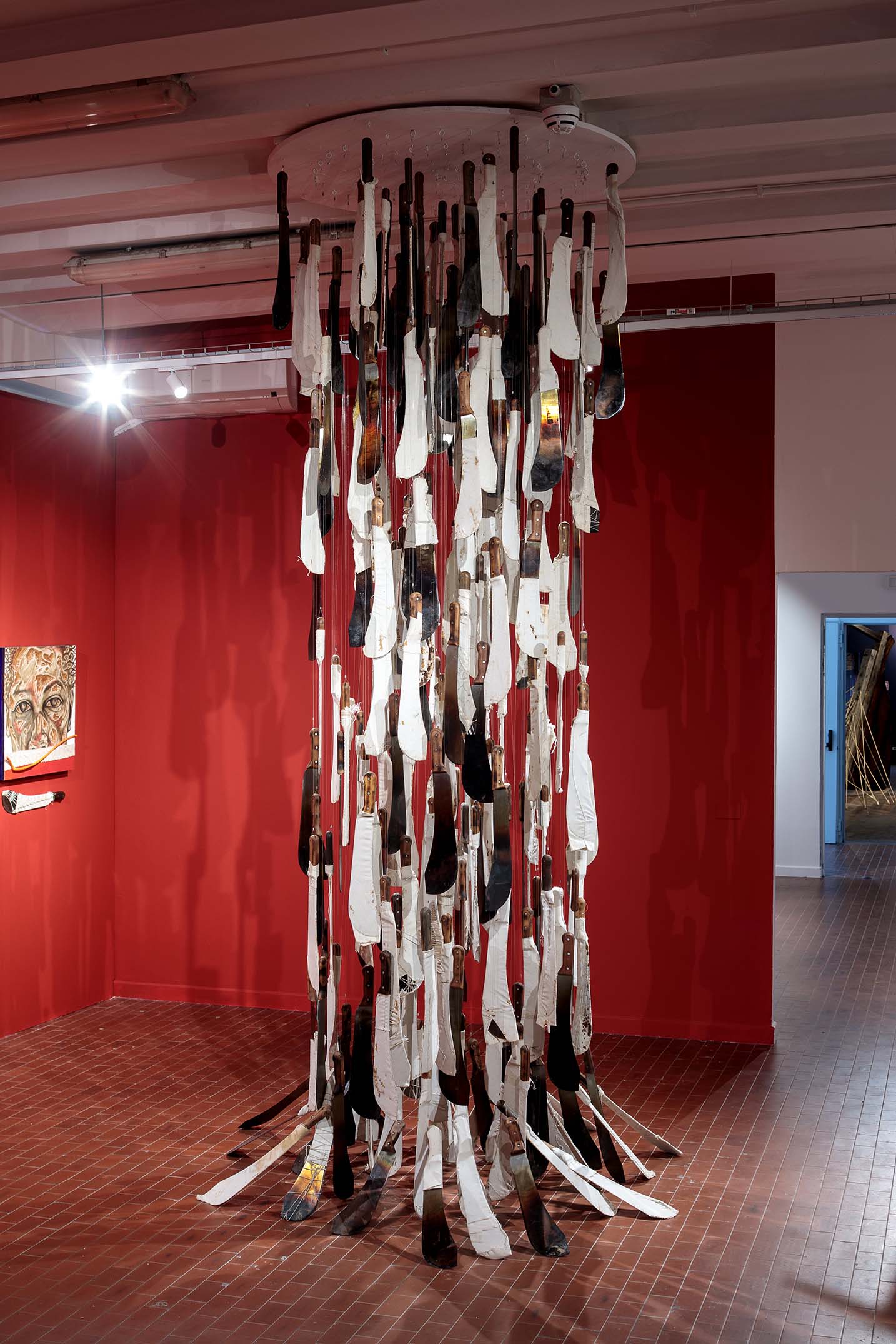
KT: The work is composed of more than 200 machetes wrapped in sailcloth that cascade from the ceiling to the floor. John became interested in the machete after observing migrants in The Bahamas carrying them through public space, often wrapped in newspaper or cloth. He saw something powerful in that gesture, the sense that people were concealing a part of themselves.
John was the son of a Jamaican migrant who married a Bahamian woman, and questions of migration, belonging and exclusion appear throughout his work. He was deeply interested in the ways migrant communities helped build Bahamian society while often remaining at its margins. The title speaks to that feeling of helping build a place while never being fully accepted within it.
The machete is an agricultural tool and an instrument of revolution. It evokes labor, resistance, survival and movement across the Caribbean. The work also references the silk cotton tree, which holds deep spiritual significance throughout the region. People leave candles there, bury loved ones nearby and may even bury a child’s navel string at its roots. The tree becomes a site of ancestral connection, history and return.
What interested me about the title was the way it continued opening onto new meanings. It spoke to migration and belonging, but it also began to resonate with Lavar’s idea of posthumous collaboration. What does it mean to enter another person’s world? To work with objects they once handled? To continue a conversation they can no longer participate in? By the end of the process, those questions had become the focus point.
PIL: If we’re stepping into the pavilion for the first time, where does the story begin?
KT: One of the first things visitors encounter is the color. Rather than the turquoise palette so often associated with The Bahamas, the pavilion is wrapped in a deep navy blue. I wanted something that felt darker, deeper and a little less familiar; something that moved away from postcard imagery and toward a different understanding of The Bahamas.
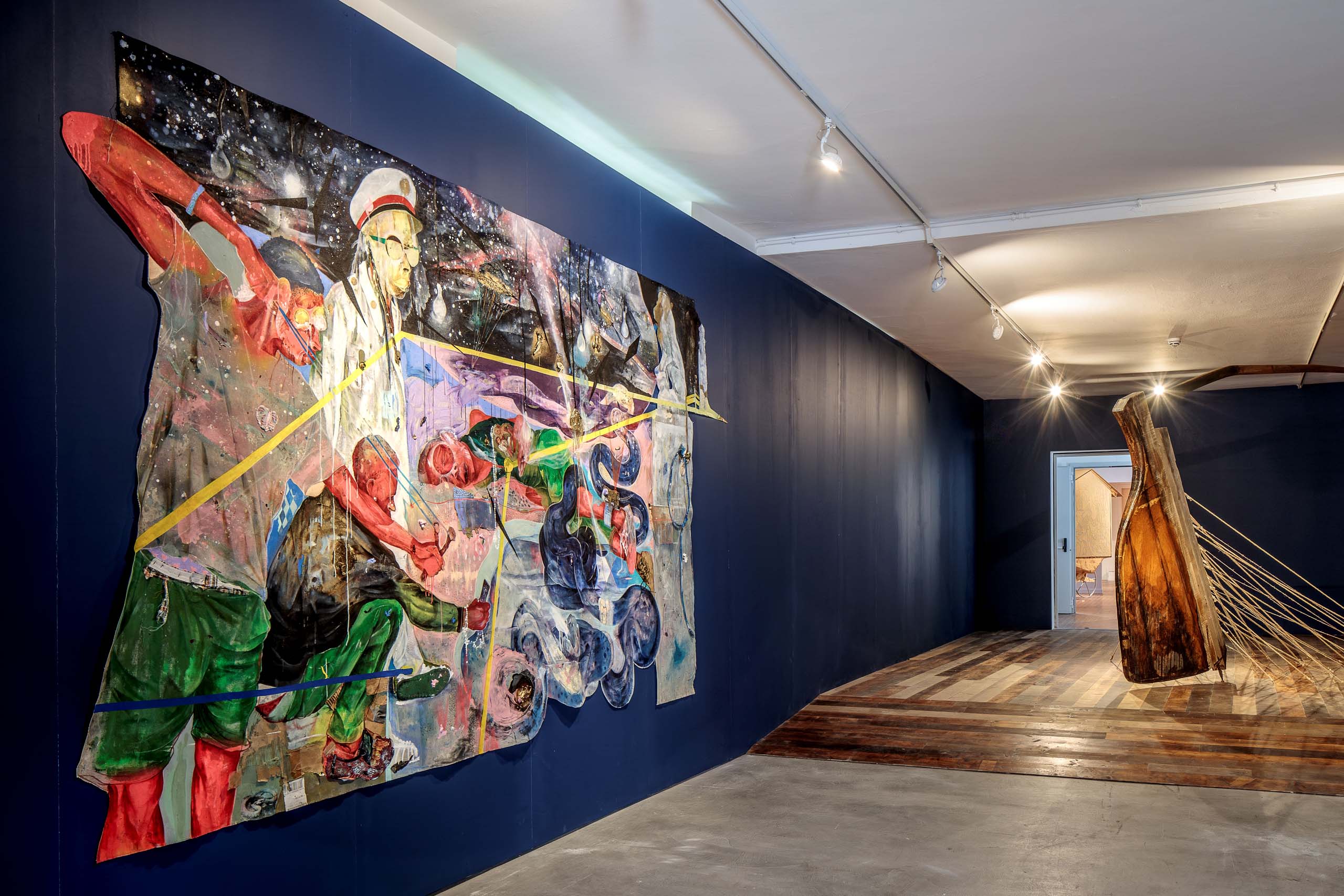
The opening work is Live Load. From a distance, it appears to be a giant wooden rudder suspended in space, balanced precariously on ropes and a small support structure. But as you move closer, you realize it’s cardboard. The rudder suggests a vessel, a journey, a passage across water. Yet the vessel itself is absent. You’re left wondering what happened to the people it carried, where they went, what became of the “live load.”
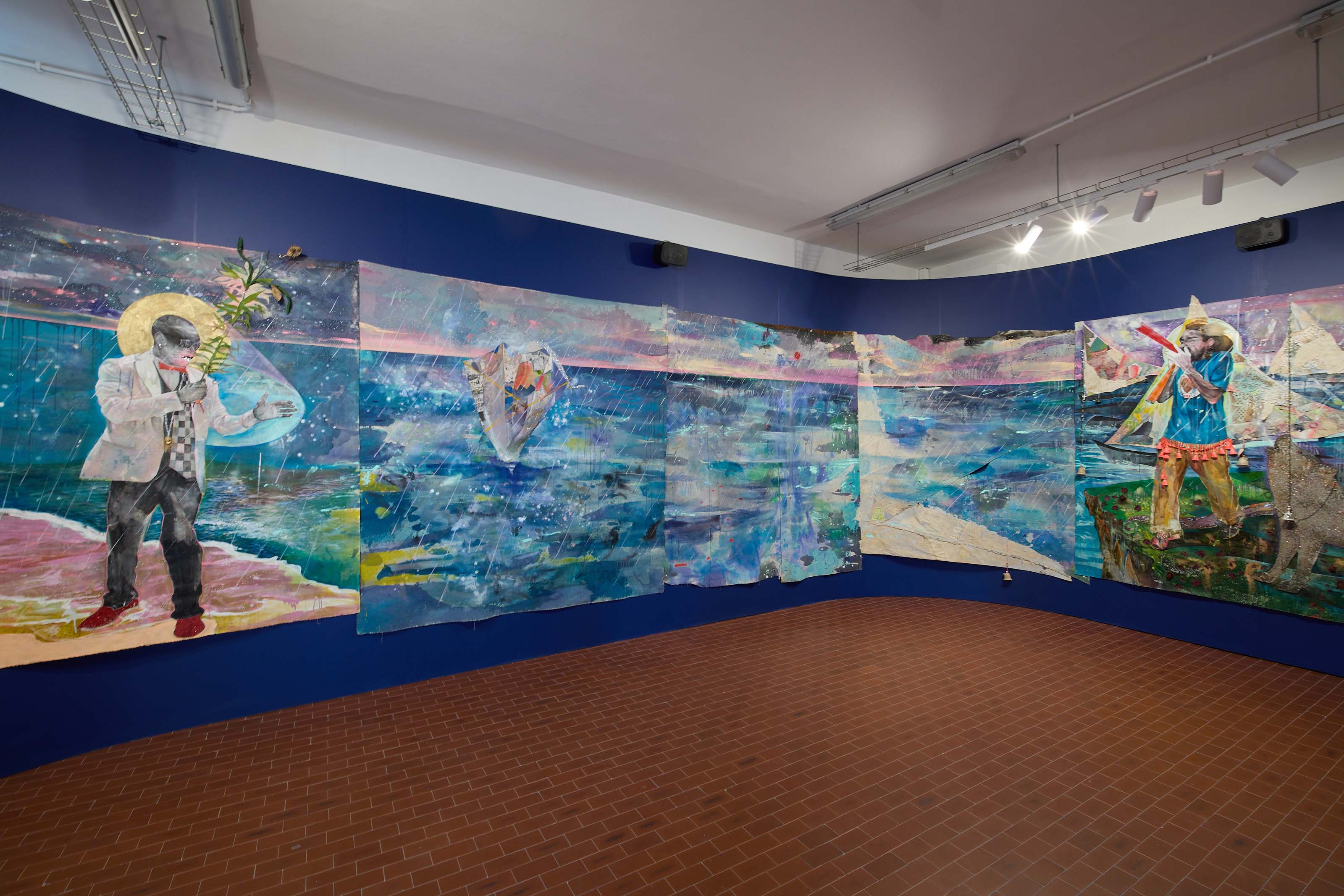
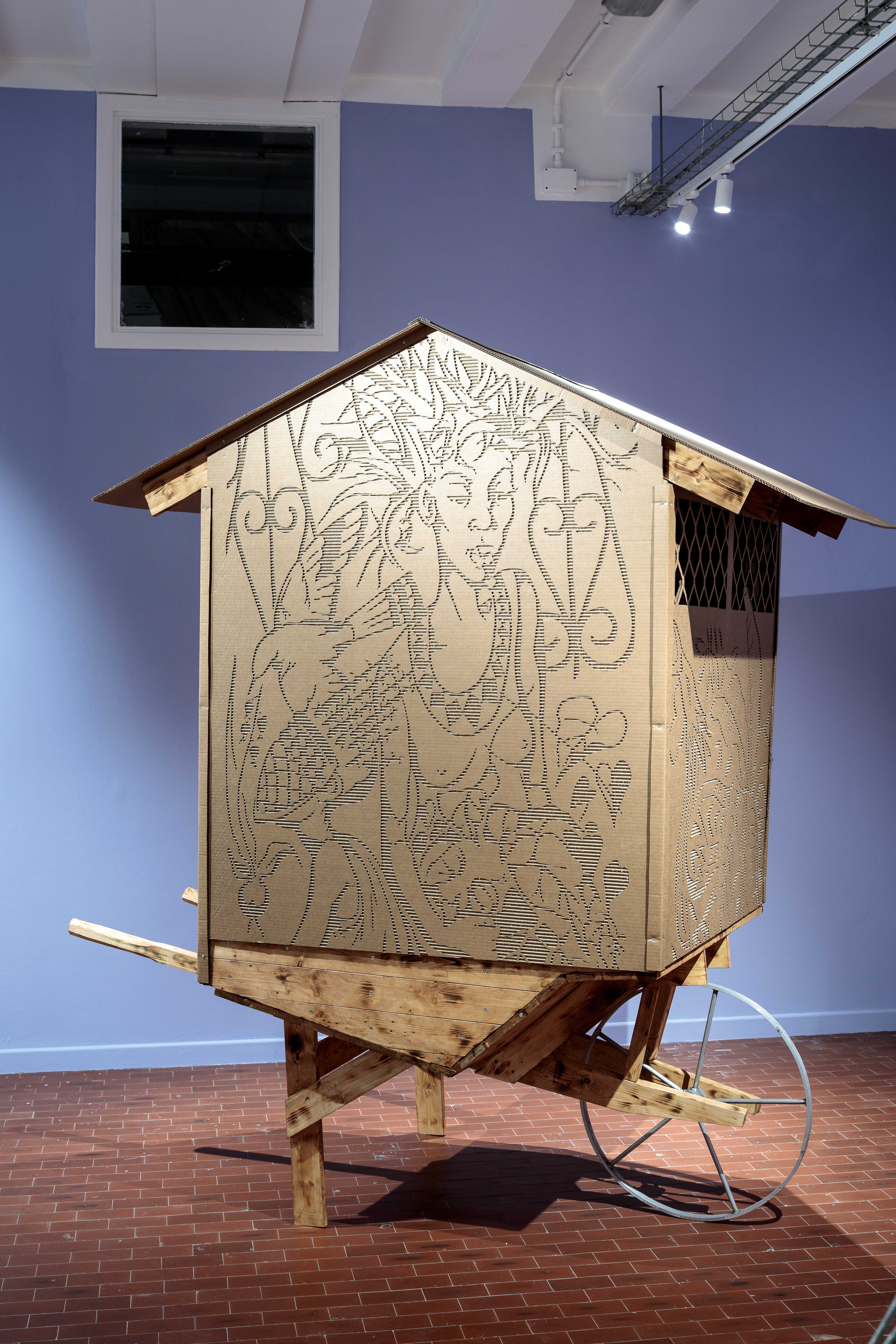
Cardboard was one of John’s most important materials. It’s the hidden infrastructure inside Junkanoo costumes — essential but rarely seen. He often connected it to migrant labor and would carve into its surface, exposing the corrugated interior and making visible what is usually hidden. Lavar’s work enters that relationship from a different direction. Several of his works take the form of a procession, drawing on the memorial traditions embedded within Junkanoo culture. Using sailcloth, masks and found materials, he creates processional figures that feel at once celebratory and elegiac. The works are deeply informed by family history and spirituality, but they also speak to broader traditions of remembrance and communal gathering. What interested me was how naturally those works resonated with John’s. Both artists are grounded in Bahamian aesthetic and performance traditions, yet each arrives there through a distinct visual language.
As you move through the pavilion, elements recur, forms echo one another, and what begins as an encounter with two artists gradually reveals a larger story about The Bahamas. Through references to the Jammin’ collaborative — of which Beadle was a member — the exhibition of which Beadle was a member, the exhibition situates both artists within a larger lineage of Bahamian cultural production.
PIL: Junkanoo runs throughout the exhibition, but perhaps not in the way many visitors might expect. What did you hope people would understand about it?
KT: Most people encounter Junkanoo through the parades. The pavilion honors a side of the tradition that is much less visible, such as rush-outs that take place when someone has passed away. People come together to celebrate that person’s life and accompany them on their journey. There’s a common story about the origin of the word Junkanoo coming from the phrase “junk anew.” Whether or not that’s historically accurate, it’s meaningful because it speaks to a culture of transformation. Traditionally, Junkanoo artists created extraordinary things from objects others might overlook or discard.
Junkanoo is not only a performance tradition. It’s also a way of thinking about memory, community, creativity and renewal. That concept is deeply aligned with In Minor Keys, the Biennale’s central theme developed by curator Koyo Kouoh, which invited viewers to pay attention to quieter forms of knowledge and connection that can easily be overshadowed by spectacle.
PIL: This year’s Biennale encourages dialogue around overlooked histories, invisible labor and voices from the Global South. Did you discover any unexpected resonances between the Bahamas Pavilion and the larger Biennale?
KT: One of the biggest surprises of Venice was discovering how extensively cardboard was used in the main pavilion. In several places, the corrugated interior was exposed and became part of the visual language. I was struck by how much it echoed John’s imagery. In pieces like Mobile Housing Scheme, he would cut away the outer surface of cardboard and reveal the corrugation beneath, transforming structure into image.
What made it remarkable was that none of it was planned. We didn’t know the central exhibition would look that way when we were developing the pavilion. Yet we found these echoes taking place across the Biennale. Visitors move through the main pavilion and then enter the Bahamas Pavilion and encounter another artist who had spent decades thinking through cardboard as both material and metaphor. It’s one of those extraordinary curatorial alignments that no one could have predicted. It also reinforces one of the exhibition’s central ideas: that objects carry histories, and that paying attention to overlooked structures can reveal entirely different ways of understanding the world.
PIL: Throughout the pavilion there’s a recurring theme of transformation. Is there something about Bahamian culture itself that encourages artists to see potential in what others might overlook?
KT: Absolutely. Traditionally, Junkanoo practitioners transformed discarded items into extraordinary creations. Cowbells were made from scrap metal. Drums emerged from discarded oil barrels. That sensibility extends far beyond Junkanoo. You see it throughout Bahamian contemporary art. Heino Schmid has incorporated Kalik bottles and coconut shells into his work, while Antonius Roberts has worked with hurricane-felled trees and reclaimed limestone blocks. Materials that might otherwise be discarded become vehicles for storytelling, artistic innovation, and cultural reflection.
These practices aren’t simply about recycling. They’re about looking closely at the world around you and recognizing possibilities where others might not. That capacity for transformation is deeply connected to Bahamian cultural history.
PIL: Every curatorial project is as much about what isn’t shown as what is. How did you navigate those decisions while shaping the pavilion?
KT: I almost think about it in the opposite way. I mostly found myself thinking about the works I wasn’t sure we’d be able to include at all. When I first started putting together an ideal checklist of John’s work, there were two pieces I desperately hoped we could secure. One was Live Load, the rudder sculpture. It hadn’t been exhibited in nearly fifteen years, and everyone I shared the checklist with kept asking, “Why do you think this work still exists?” There was a genuine question about whether it had survived, and if it had, whether it would still be in a condition to show.
The other was Mobile Housing Scheme, which had unfortunately been destroyed by termites. Those experiences reinforced something that became central to the curatorial process. A Venice pavilion isn’t a retrospective. You’re not trying to tell the entire story of an artist’s career. You’re trying to distill decades of work into a small number of pieces that can stand in for a much larger body of work. Both artists have developed expansive bodies of work over decades. The challenge was identifying the pieces that could carry the weight of the larger whole and tell the story most clearly.
PIL: Much of your scholarship has explored how the Caribbean has been imagined through tourism. What do you hope visitors take away from this pavilion – and perhaps from The Bahamas itself?
KT: I’d like visitors to encounter a Bahamas they weren’t expecting. Rather than reproducing familiar images, the pavilion invites people to engage with histories, materials, traditions and artistic practices they may never have associated with the country before. I hope people discover the extraordinary artistic community that exists in The Bahamas. The beaches are beautiful, of course, but so is the artistic community. In some ways, that’s what the exhibition is really asking visitors to do: to look beyond the postcard.